
What is Land and Expand?
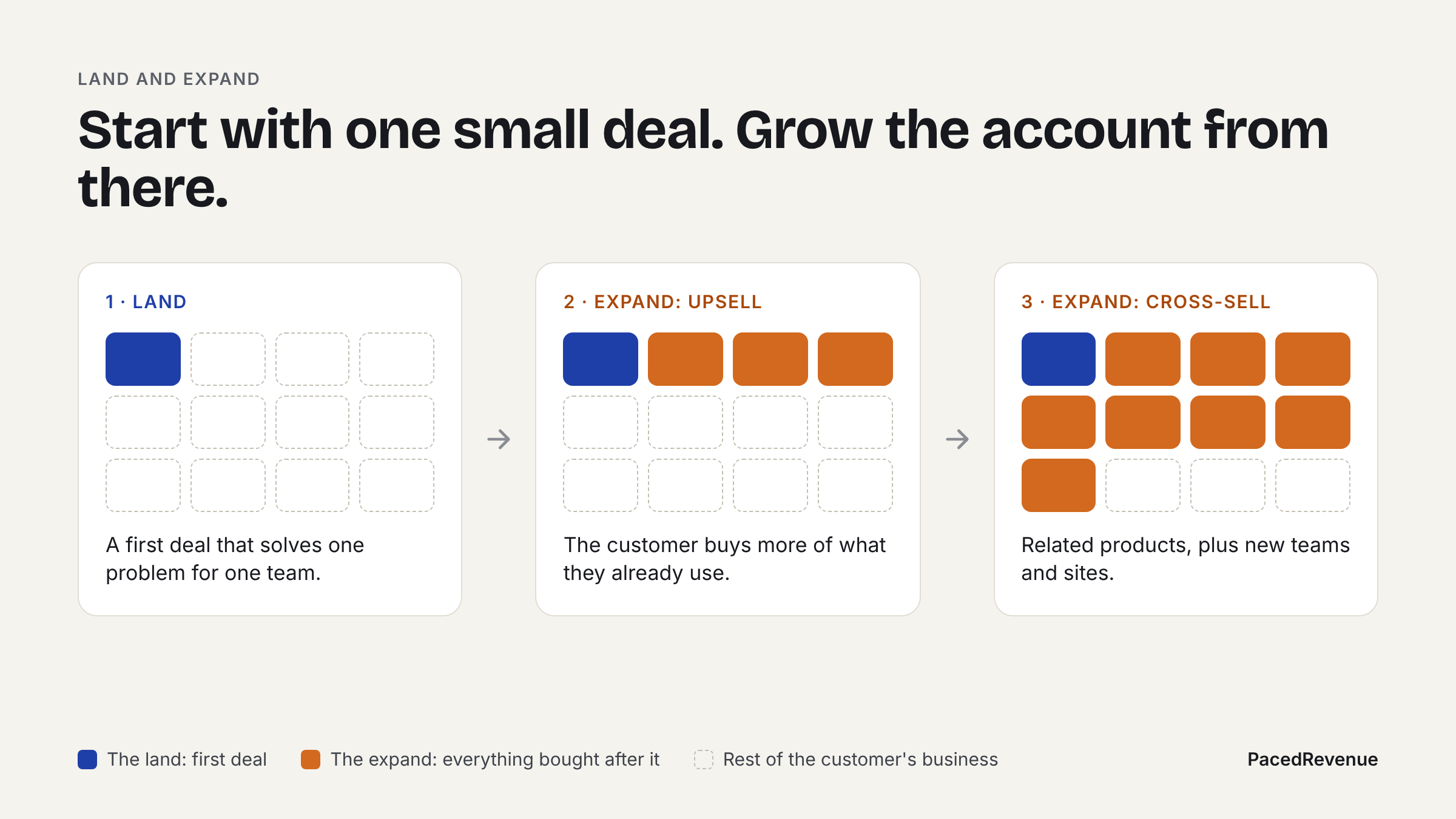
Land and expand is a sales strategy where you win a small first deal with a new customer, then grow that customer’s spending over time. The small first deal is the “land”. Everything the customer buys after it is the “expand”.
The land is the first, smaller deal with a new customer. Its job is to give you a foothold in the customer’s organisation by solving one specific problem. A strong land shows value early and builds the customer’s trust in you.
The expand is everything the customer buys after the land. They buy more of what they already use (upselling) and add related products from you (cross-selling). Each new purchase comes more easily, because the customer already trusts you.
Why It Works
The land and expand model works because a small purchase is an easier decision for the buyer, and once you’ve delivered, you’re the easiest choice for the next purchase.
A small first deal is an easy yes for the customer. They can try you on one team or one site without a large commitment, and you learn how their business works before the account grows.
Once the first deal has worked, the next sale starts from a stronger position. The customer knows how you work and has seen results with their own people. Your contract, invoicing and contacts are already set up on their side. A competitor trying to win the same work would have to start from nothing.
Growing an existing account also costs less than winning a new customer. You already know the people, and they already trust you. Most of the sales effort goes into understanding what else the customer needs.
What a Land and Expand Strategy Involves
A land and expand strategy has two phases. The land phase wins the first deal, and the expand phase grows the account from there. Each phase needs its own plan.
The “Land” Phase
The land phase is about deciding what the first deal should include. The deal has to be small enough for one budget holder to approve. It also has to be big enough to produce a result the customer can see, because that result is what leads to the next purchase.
The best first deals solve one clear problem for one group of people. Pick a problem the buyer already measures, so both sides can tell whether the first deal worked. That measured result also gives the buyer something to show their manager when it is time to buy more.
Price the first deal at a level you are happy to keep. The customer will expect the same price when they buy more, so the first price sets the level for the whole account.
Then show the value early. Share the first results with the team that bought, in the numbers they already use, so they have a success story to pass on to their colleagues.
The “Expand” Phase
The expand phase starts when the first deal begins to work. By now the customer’s own staff are using what they bought and can see what it does for them. That first-hand experience makes the next purchase easier to agree. The expand phase builds on it, adding more people and related products to the account.
Account growth depends on how you sell and onboard as much as on the product itself. Planning that growth into your sales process is part of PacedRevenue’s go-to-market agency work with B2B teams.
Some of that growth comes from the customer’s own success. As their business grows, they add people, sites or usage to what they already buy, and a product that fits their work grows with them.
More growth comes from new needs. Customers buy a bigger version of what works for them, or add related products from you that solve nearby problems.
Each account has an owner on your side, usually an account manager or the customer success team. They help the customer get more from what they bought and learn where else in the business the same problem exists.
How It Fits the PACED Framework
PacedRevenue’s PACED framework splits the revenue engine into five gates: Position, Activate, Capture, Embed and Develop. Each gate depends on the one before it, so a weak gate early on limits everything after it. A land and expand strategy runs through all five. The land covers the first three gates and the expand covers the last two.
Position. You reach the right buyer for the first deal, with a problem they already know they have.
Activate. The person who signs is convinced, not just the contact who first showed interest.
Capture. The first deal is signed and paid.
Embed. The customer reaches the result they bought. A customer who never gets there has nothing to expand.
Develop. The account grows through more users, sites and products. This is where renewal and account growth are planned.
Develop also feeds back into Position. The accounts that grow the most show you who to land next, which problem to lead with and what to sell first.
An account that stops growing has often stalled at an earlier gate. The customer may never have reached the result they paid for, or the first deal may have been sold to the wrong buyer. Before you push for the next sale, check which gate the account stalled at.
Land and Expand Examples
These three land and expand examples follow the same pattern in a software company, a services firm and a supplier of physical products. The businesses are made up for illustration.
A Software Tool That Starts With One Team
Land: 15 licences for one team
A company sells software for handling customer support requests. Its first sale to a logistics firm is 15 licences for the customer service team, which keeps losing emails from clients. The team lead approves the purchase from her own budget.
Expand: Four Departments and a Company-Wide Contract
Within two months, her team answers clients faster and stops losing requests. She mentions the change at a management meeting. The finance team handles billing questions from the same clients, so its manager asks to try the software. The supplier adds 10 licences to the existing contract, and finance is set up within a week.
A year later, the logistics firm has 120 users across four departments. The IT director now wants one company-wide contract, with central control over who has access. The supplier agrees a larger annual deal and adds a reporting product that the department managers had been asking for.
An IT support firm That Starts With One Office
Land: A Support Contract for One Office
An IT support firm signs a one-year contract to look after one office of a professional services company.
Expand: All Three Offices, Then Security Training
Fixes in that office now happen the same day, so at renewal the company adds its other two offices. The following year it also buys security training for all its staff.
A workwear supplier that starts with one site
Land: A Uniform Order For One Factory
A workwear supplier wins a uniform order at one of a food manufacturer’s five factories.
Expand: All Five Factories and Safety Equipment
The order arrives on time and in the right sizes, so the site manager recommends the supplier to head office. The contract grows to all five factories, then adds safety boots and gloves.
How To Start a Land and Expand Sales Strategy
To start a land and expand sales strategy, plan the expansion before the first sale. Then organise your offer and your teams around growing each account.
- Keep the first deal small on purpose. Sell the customer what solves their most pressing pain point. Their other needs become later purchases once the first deal has worked.
- Map where your product helps across the customer’s business. Before the first sale, work out which other teams or sites share the same problem. That map shows where each account can grow next.
- Build your offer so it can grow in steps. Package your product or service in parts a customer can add one at a time, such as extra users or extra sites.
- Give your customer-facing teams one plan per account. Sales, marketing and customer success work from the same account goals. The customer then hears one consistent message from the first deal to renewal.
- Let the product make the case. Act on the first team’s feedback so the product keeps working better for them. Their results then reach the rest of the business through their own colleagues.
- Watch how customers use what they bought. Usage, support requests and results show when an account is ready for more. Raise the next purchase as soon as those signs appear.
- Shape each expansion around the customer. Base the next offer on that customer’s own goals and results.
The Role of Technology in Land and Expand
The strategy depends on knowing where each account stands, and a few tools make that visible to everyone who works with the customer.
- CRM. Holds each account’s contacts and purchase history, so every team works from the same picture.
- Usage and service data. Shows how much each customer uses what they bought, which signals when an account is ready for more.
- Customer success tools. Track onboarding and renewal dates for each account.
- Quoting and billing. Lets you add users, sites or products to an existing contract without a new sales process each time.
Where to start with your own accounts
List the customers you won last year and mark which accounts grew and which stayed at their first deal, then check the second group against the common reasons customer spend doesn’t grow. For the growing accounts, look at what they had in common, from the size of the first deal to how they were onboarded. If you want help planning how your accounts grow, take the free revenue self-assessment or book a call with the PacedRevenue team.