
Founder-led sales development challenges are the problems that come up when a company's founder personally finds prospects and carries them through to a signed deal. Most of them share one source, which is that both the selling hours and the knowledge of what works belong to one person. They ease as the founder turns what works into written rules and hands routine work to other people and tools.
What Is Founder-Led Sales?
Founder-led sales is the stage where a company's founder, or one of its founders, runs selling personally before a sales team exists. It usually covers the period from the first paying customers to the first sales hires, while the company's go-to-market strategy is still taking shape. Founders sell at this stage because they can answer product and roadmap questions on the spot, and what they hear on calls goes straight into product decisions.
How Does Founder-Led Sales Work?
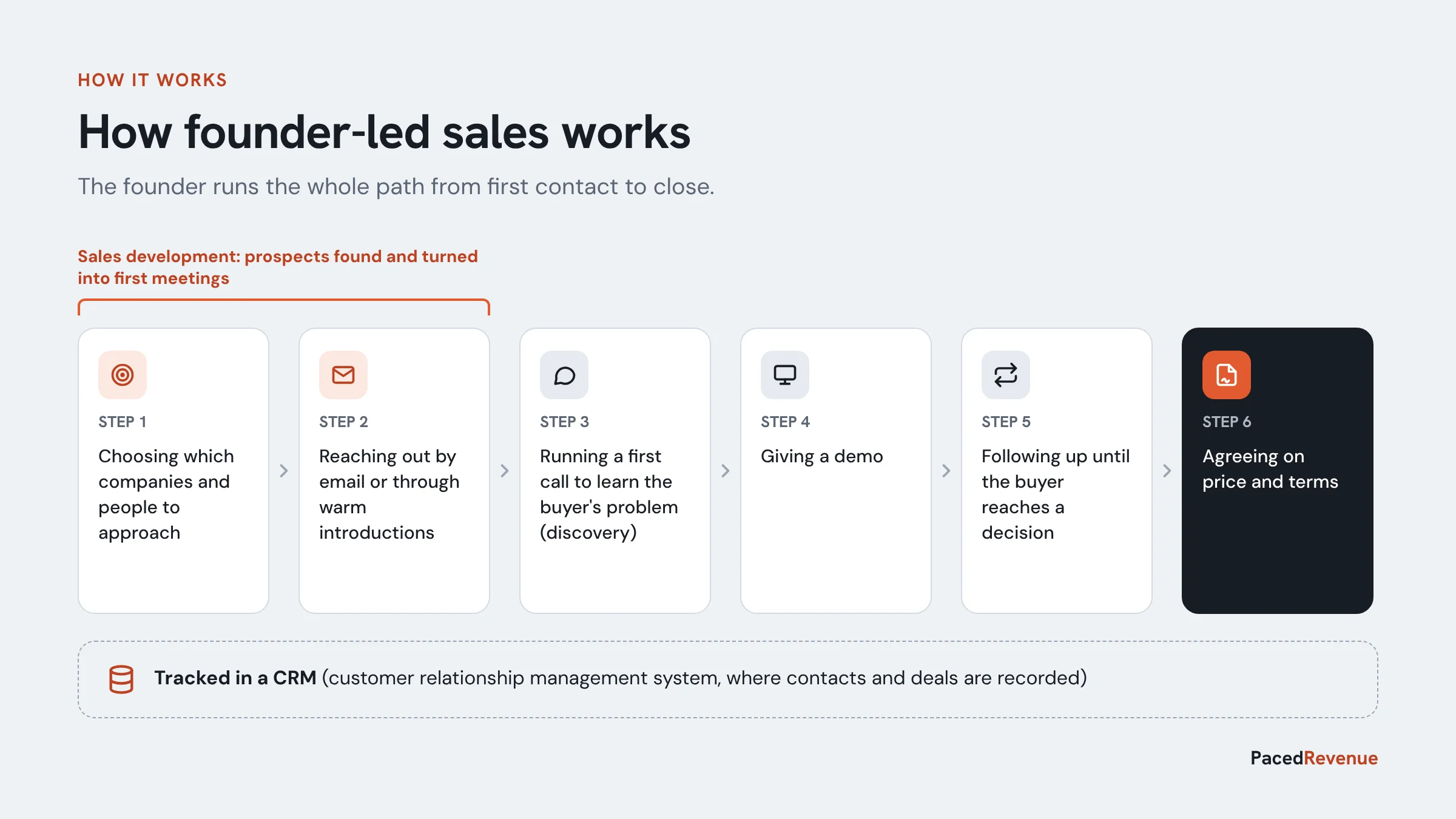
The founder runs the whole path from first contact to close. The front part of that path, where prospects are found and turned into first meetings, is called sales development. A typical cycle includes:
- Choosing which companies and people to approach
- Reaching out by email or through warm introductions
- Running a first call to learn the buyer's problem (discovery)
- Giving a demo
- Following up until the buyer reaches a decision
- Agreeing on price and terms
Most founders keep track of this work in a CRM (customer relationship management system, where contacts and deals are recorded).
10 Common Founder-Led Sales Development Challenges
1. Limited Founder Bandwidth and a Growth Ceiling
A founder's week holds product decisions, hiring, investor meetings and customer support, and sales gets the hours that remain. New revenue then grows in step with the founder's free time. Once the calendar is full, growth levels off even when more buyers are interested, a pattern often called the founder trap.
2. Founder Dependency and Key-Person Risk
Buyers build their relationship with the founder, and many expect the founder on every call. The details of each deal sit in one person's memory, including objections and the reason a buyer moved forward. When the founder is away or busy with other work, deals wait for their return.
3. Lack of a Repeatable Sales Process
Founders adjust the pitch as they learn, which suits the earliest calls. Over time, the story on one call drifts from the next, and the stages a deal passes through are never named. A process that lives as habit is hard for another person to pick up, so a repeatable sales process takes deliberate work to build.
4. Selling Features Instead of Solving Customer Problems
Founders know the product in detail and enjoy showing how it works. Demos turn into tours of every feature, and discovery gets shorter to make room. The buyer is then left to work out what the product changes for their business.
5. Inconsistent Pricing and Custom Deal-Making
Early prices are often set on the call and adjusted for each buyer, sometimes with custom features added to close the deal. Each customer ends up on different terms. Revenue per customer becomes hard to compare, and a future salesperson has no reference price to quote from.
6. Delegating Too Early or Scaling Too Late
A first sales hire made before the process is written down ends up inventing their own approach, which makes their results hard to judge. Holding on too long works the other way, with qualified prospects queuing for a meeting slot while the founder runs every deal.
7. An Unclear Ideal Customer Profile
Many first customers arrive through the founder's network or with an unusual use case, which makes the pattern of who buys hard to see. Target lists then stay broad, and the ideal customer profile (the type of company most likely to buy and do well with the product) stays a guess.
8. Inconsistent Prospecting and Follow-Up
Prospecting happens when the founder has a free afternoon, so outreach comes in bursts. Pipeline rises after a busy outreach week and thins out a few weeks later. Follow-ups slip in heavy weeks, and interested prospects wait longer for replies.
9. Spending Too Much Time on Unqualified Leads
In the first months, every conversation feels worth having, so founders take most meetings that come their way. Full demos go to companies outside the target market or with no pressing problem. The pipeline looks larger than the business it will produce, and selling hours spread across deals that rarely close.
10. Limited Visibility into Pipeline Performance
Deals are tracked across the founder's inbox and memory. Few records show how long deals take or which sources produce customers. Sales forecasting becomes difficult, as does telling whether a slow month comes from the market or from the process.
How to Overcome Founder-Led Sales Development Challenges
1. Protect Selling Time and Delegate Routine Sales Tasks
Fixed hours each week for discovery calls and closing conversations give sales a protected place on the founder's calendar. Routine work can move to a part-time SDR (sales development representative, who finds prospects and books meetings) or to software. Good candidates for handing off include:
- Scheduling, through a booking link prospects use directly
- First-touch emails and follow-ups, through an email sequencing tool
- Building account and contact lists
- Updating the CRM after calls
2. Build Customer Relationships Across the Team
A second person on early calls, such as a co-founder or a product lead, gives each buyer more than one contact. The founder introduces them by name and role, and that person becomes the day-to-day contact after the deal closes. Call recordings and shared CRM notes give everyone the same context on each account. Where there are co-founders, one usually leads sales and the other joins calls that need their expertise, such as technical evaluations or security reviews.
3. Document a Sales Playbook Others Can Follow
A sales playbook is a working document describing how the company sells, built from the founder's recent won and lost deals. It usually holds:
- A one-page positioning story covering the problem, why it matters now and why this product solves it
- Discovery questions
- Answers to recurring objections
- Proof points such as case studies or reference customers
- A demo outline
- Deal stages with clear entry and exit criteria
It also links to the ICP and to the pricing and qualification guidelines described below. The playbook changes as new objections appear, so it stays a draft that keeps improving.
4. Lead with Customer Problems and Business Outcomes
Discovery comes before the demo. Questions that uncover customer pain points include:
- How do you handle this today?
- What does the current approach cost your team in time or effort?
- Who else on the team feels this problem?
- What would a good result look like a few months from now?
The sales demo then shows only the parts of the product that address what the buyer described. Outreach follows the same order, opening with a trigger the buyer recognizes, such as a funding round or a new leadership hire, and describing the problem in words taken from past calls.
5. Set Clear Pricing, Discount and Scope Guidelines
A simple price list or set of tiers, based on value-based pricing, gives every deal the same starting point. Discounts work best within a set range and in exchange for something clear, such as a longer contract or a case study. Each package comes with a scope list of what it includes, and custom requests go to the product roadmap or become a separately priced service. A first price the company is happy to keep as accounts grow makes later deals easier.
6. Match Sales Hiring and Handover to Business Readiness
A hire works best when the founder's limit is time. When the limit is method, and deals close only when the founder runs them, the playbook comes first. Two first roles suit different situations:
- SDR. An SDR suits a founder who closes well and runs short of hours.
- Account executive (AE). An AE runs deals from first meeting to signature. It fits a company whose new leads come mostly from outside the founder's network and whose playbook a new person can follow.
The transition out of founder-led sales happens in stages. A new hire starts with follow-ups and routine deal steps, while the founder keeps introductions and the larger calls. Call shadowing and weekly deal reviews let the hire learn the reasoning behind each step. New salespeople need time to learn the product and the accounts before they reach the founder's pace.
7. Define Your Ideal Customer Using Evidence from Existing Deals
Each customer gets a tag for where they came from, such as the founder's network or outbound. Comparing customers then shows what the best ones share, including industry, company size, the problem they had and how quickly they closed. When customers with no link to the founder buy for the same reasons, demand is repeatable, which is a core sign of product-market fit. The written ICP lists those traits along with signals that a company is ready to buy, such as a growing team in the function the product serves or a recent switch away from an older tool.
8. Establish a Consistent Outreach and Follow-Up Schedule
Outreach runs on a cadence, with a set number of new accounts from a B2B prospect list contacted each week, so new conversations start at a steady rate. Each prospect follows a planned sequence of outbound sales touches across email and LinkedIn. Every call ends with an agreed next step and a date, logged in the CRM as a task. Inbound inquiries get a reply the same working day.
9. Qualify Prospects Before Committing More Selling Time
A short lead qualification call before a full demo shows whether a prospect is worth more of the founder's time. Common criteria include:
- A match with the ICP
- A problem the buyer describes in their own words
- A reason the problem matters now
- Interest from the people who would use the product
Prospects who meet the criteria move to a demo. Others receive useful resources and a check-in at a later date.
10. Track Pipeline Stages, Conversion Rates and Stalled Deals
Every deal sits in the CRM at a named stage, using the stage definitions from the playbook. A short weekly review covers:
- Conversion from first meeting to qualified opportunity
- Conversion from opportunity to closed deal
- Average deal size and sales cycle length
- Pipeline by source
- Stalled deals that have not changed stage in the past few weeks
Each lost deal gets a one-line reason. Over a few months, these figures become the benchmark for forecasting revenue and for judging new channels and new hires.